Chasing Invoices as a Freelancer: The Order That Works
Chasing invoices as a freelancer: the order that works, from the first written reminder to the fourth-week decision, with the wording for each step.
By Notion Freelancer OS by Cosmo Suite · Editorial policy
Published · 10 min read
Chasing invoices feels like asking a favour, which is why it gets put off. You delivered the work, the invoice states the amount and the date, and the client agreed to both.
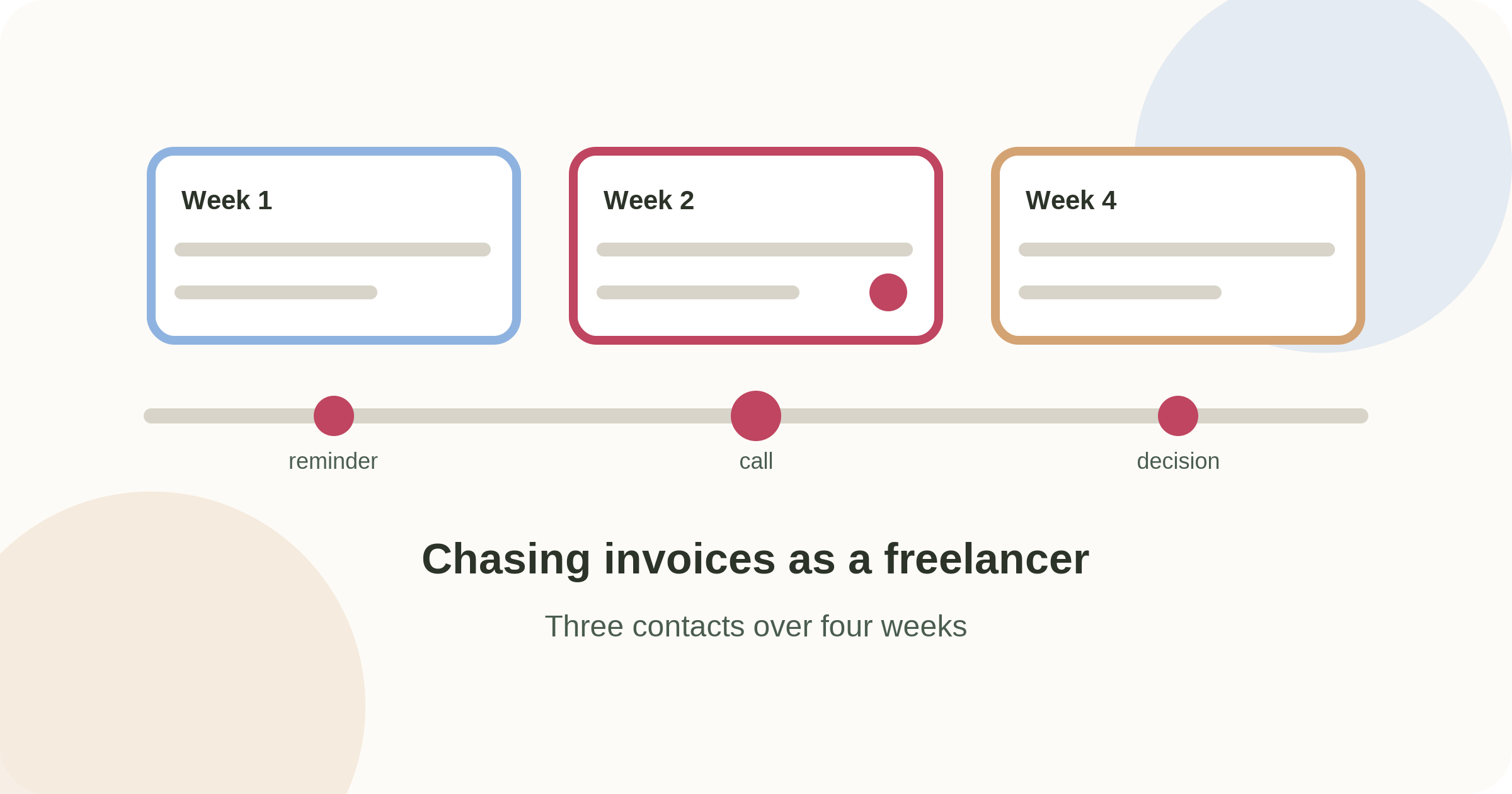
The order that works is three contacts over four weeks. A written reminder in the first week, a phone call in the second, and a decision in the fourth. Each step has one job, and each one tells you whether the next is needed. Most advice stops at "be polite and persistent", which leaves you writing a fourth email and still waiting.
The order below gives the wording for each step, and the point where chasing stops being a reminder and becomes a choice. For example, a $2,400 invoice that falls due on 4 November is a week-one message on 5 November, a call by 12 November, and a decision by 2 December.
Key Takeaways
- Three contacts across four weeks: written reminder, phone call, decision.
- The first week is a reminder, not a chase. One message, one question, four to six sentences.
- The second week changes the channel, because a reply that never came is a channel problem before it is a money problem.
- The fourth week is a decision, not a fourth email: pause future work, apply an agreed late fee, or stop.
- An outstanding invoice and an overdue invoice are different things, and only the second one starts the clock.
The chasing order, in one table
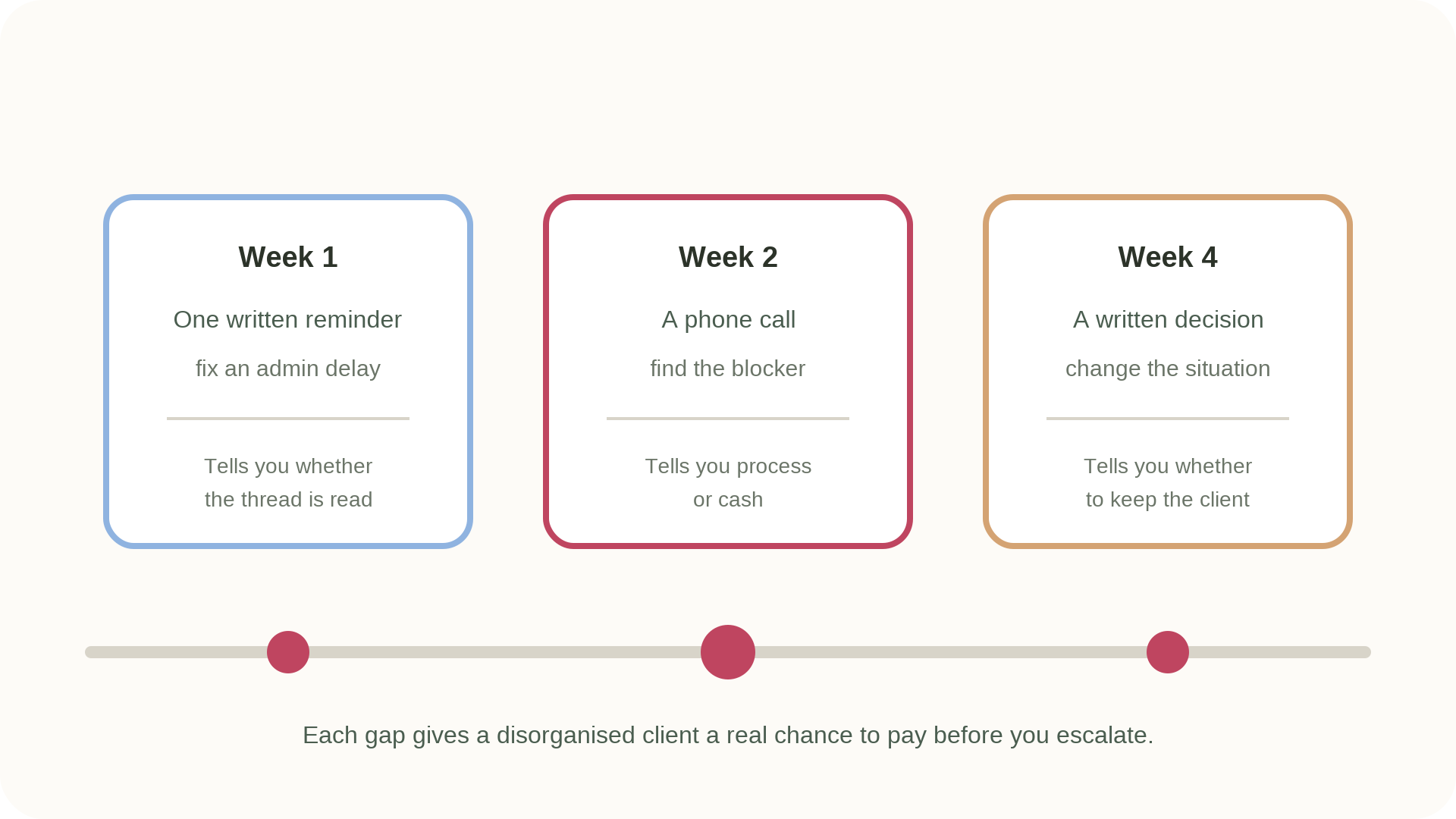
Chase in three steps spread over four weeks, and stop writing after the third. The spacing matters more than the wording, because each gap gives a client who is merely disorganised a real chance to pay before you escalate.
| When | What you do | What it is for | What it tells you |
|---|---|---|---|
| Week 1, the day after the due date | One written reminder, same thread as the invoice | Fix an administrative delay | Whether anyone is reading the thread |
| Week 2 | A phone call to the person who approves the invoice | Find the real blocker | Whether the delay is process or cash |
| Week 4 | A written decision: pause future work, apply an agreed late fee, or stop | Change the situation, not the wording | Whether this client is worth keeping |
Two words do a lot of work here. An outstanding invoice is unpaid but may still be inside its terms. An overdue invoice, also called a past due invoice, has passed its due date, and only the second kind starts the order. If your list mixes the two, you will chase invoices that are not late yet, and the client will notice.
That list is the part most freelancers skip. Before the first message, you need one place that shows every unpaid invoice with its client and its date, sorted by age. A workspace that keeps the invoice row, the client and the due date on the same record does that without a second spreadsheet, and the sending stays yours.
The first week: one written reminder
Send one message the day after the due date, in the same email thread as the invoice, and then wait three working days. The first contact is a reminder. It is not the place for a stronger tone, because you do not yet know why the invoice is unpaid.
Write the invoice number, the amount and the due date in the first sentence. Then ask one question. That structure is the whole of it, and it is the same structure at every later point, which is why it is worth writing once and saving.
Invoice 2087, $2,400, fell due on 4 November. Is there anything you need from me before it can be paid?
That question does more work than a demand. It gives the client a true answer that is not "I have no money", and it often surfaces something small, such as a missing purchase order number, a copy that went to an old address, or an approval that nobody chased.
Leave out the softening words, such as "just", "bumping this" and "sorry to bother you". Each one apologises for a message the client has not objected to, and each one pushes the facts down the paragraph, which is where a delay starts. For example, "Just bumping this in case it got buried" takes fewer than 40 characters to say nothing the client did not already know.
The four dated points that come before and after this one, including the note sent three days ahead of the due date, are in the reminder schedule with a message for each point. This guide picks up where a reminder has been sent and nothing has happened.
The second week: change the channel
Call the person who approves the invoice, not the person who hired you. A written reminder that gets no reply is usually a channel problem before it is a money problem, and a two-minute call finds out which one you have.
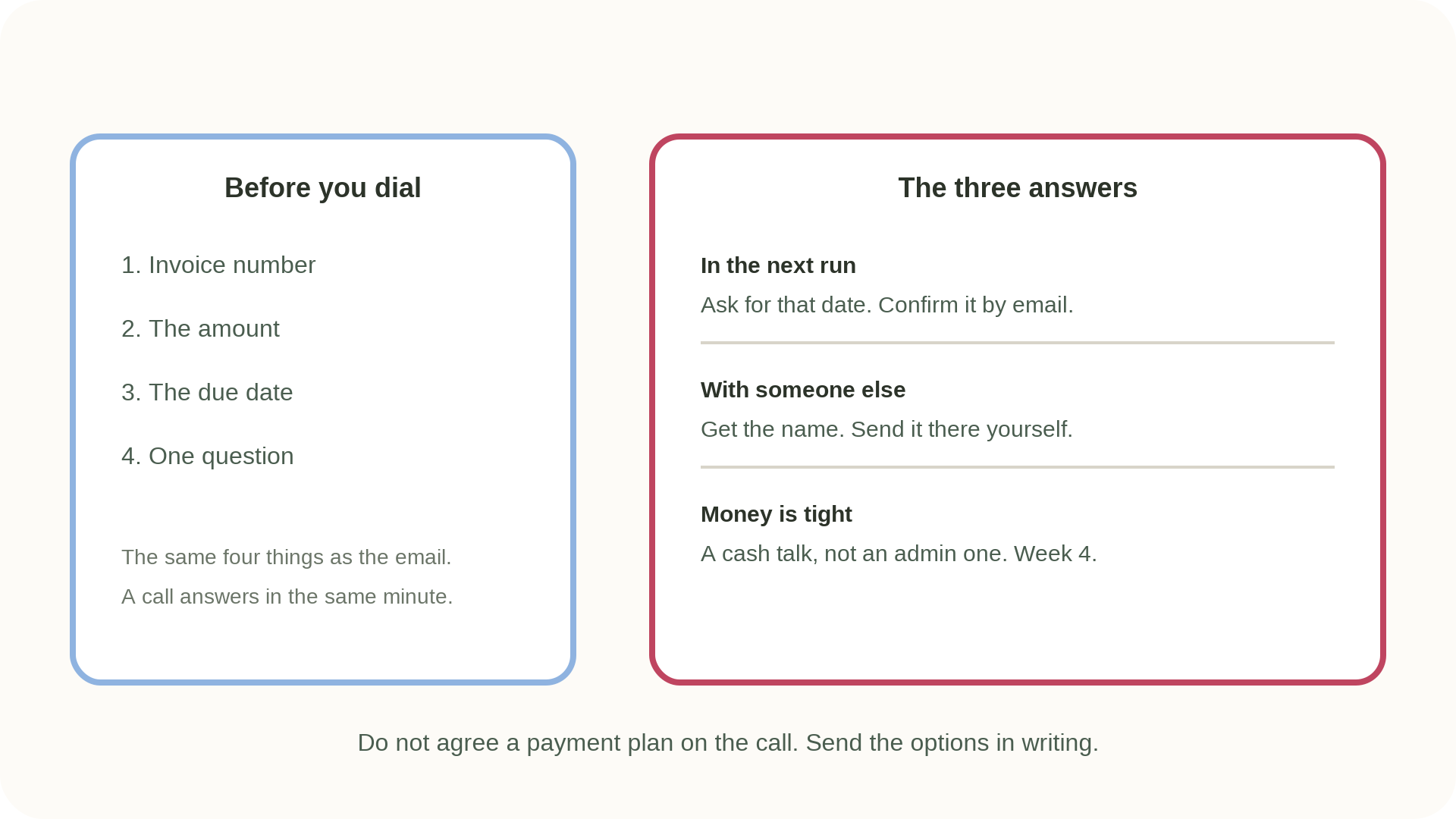
Prepare four things before you dial: the invoice number, the amount, the due date, and one question about what is holding it up. That is the same four things as the email. The difference is that a call gets an answer in the same minute.
Keep the call short and keep it warm. Say who you are, name the invoice, and ask whether it has reached the right person. Then listen. Most of the time you get one of three answers, and each one tells you what to do next. For example, a client who says the invoice is waiting on a purchase order has given you a task you can finish the same afternoon.
- "It is in the next run." Ask for the date of that run. Write it down and send a one-line email confirming it, so the date exists outside the call.
- "It is with someone else." Ask for that person's name and send them the invoice yourself, copying the person who hired you.
- "Money is tight." Now you have a cash conversation, not an admin one. That belongs in the fourth week, not this call.
Leave the payment plan for later in the week. You do not have the numbers in front of you, and a plan agreed in a hurry is the plan that gets missed. Say you will send the options in writing, then send them.
The fourth week: the decision
The fourth week is a decision, not a fourth email. You have asked twice, in two channels, and the invoice has still not moved. Another message changes nothing, so change the situation instead.
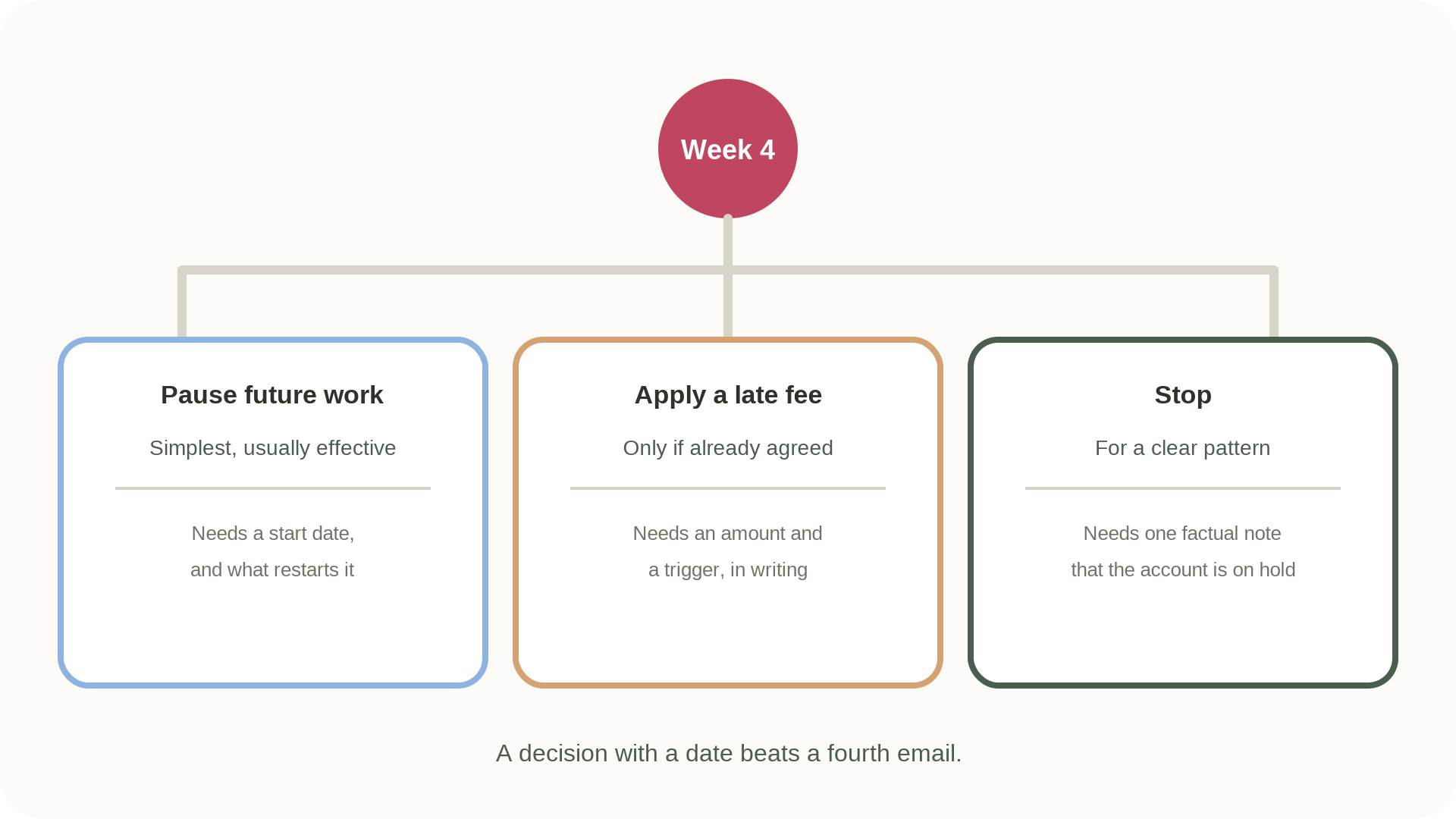
There are three options, and they are not ranked, because the right one depends on the client and the amount.
Pause future work. This is the simplest option and usually the most effective. Say that new work is on hold from a stated date until the invoice clears, and that work already promised continues. A pause is a fact the client can plan around, which is why it moves more invoices than a firmer sentence.
Apply a late fee. A late fee is a charge added to an unpaid invoice after a stated date, and it has to exist in the agreement before the invoice does. Use one only if it was agreed in writing, with a stated amount and a stated trigger. A fee added in week four to an invoice that never mentioned one is a negotiation, not a charge. Check the rule in your own jurisdiction before you rely on it.
Stop. Stop working, stop replying within a day, and send one written note that says the account is on hold. Keep it factual. This is the option for a client whose pattern is clear, and it is cheaper than a fourth month of hoping.
Write whichever one you choose, give it a date, and say what restarts it. "New work is on hold from 2 December until invoice 2087 clears" gives the client something to act on, and "I really need this paid" does not.
The wording that does the work
Every message in the order uses the same first sentence and a different question. That is what makes the escalation feel calm from the client's side, even when it is firm from yours.
| Step | First sentence | The question |
|---|---|---|
| Week 1 | Invoice 2087, $2,400, fell due on 4 November. | Is there anything you need from me before it can be paid? |
| Week 2 (call) | I am calling about invoice 2087, due 4 November. | Has it reached the right person for approval? |
| Week 4 (written) | Invoice 2087 is now 26 days past due. | Can you confirm a payment date this week, or tell me what is holding it up? |
The facts stay fixed and only the ask moves. A client who sees the same three facts each time reads a system rather than a mood, and a system is harder to ignore than a person having a bad week.
When a client offers a part payment, write back the same day with the new date and run the order again from there for what is left. A part payment is any amount below the invoice total: it moves the due date for the balance, and the invoice number stays the same. Without that written date the balance drifts, and you are working from memory again.
If you have several of these running at once, the harder problem is not the wording. It is keeping track of which invoices are unpaid and which of them have gone quiet, which is a different job from writing the message.
What actually moves a late invoice
The lever that works is the moment the invoice becomes somebody's problem rather than a document in an inbox. A stronger sentence on its own changes nothing.
A named person beats a company. "Accounts payable" cannot answer a question. A person can. Ask for the name on the second contact, and write to that person from then on.
A date beats a demand. Every message should end with a date the client can accept or refuse: the payment run, the approval meeting, the Friday. A demand with no date has nothing to agree to.
A consequence beats a reminder. The fourth week works because something changes: work pauses, a fee applies, the account is on hold. Without a consequence, a fourth contact is just the third one again.
A record beats a memory. The reason chasing goes wrong is usually not tone. It is that the freelancer cannot remember which invoice was chased when, so the second message repeats the first and the fourth never happens. One row per invoice, with the due date and the last contact, removes that failure.
A written follow-up beats a recalled one. After each contact, write one line in the record: the date, the channel and what the client said. For example, "12 November, call with Priya, invoice is with finance, payment run on 20 November". That line is what the next message quotes, and it is the reason a client who changes their story cannot change it twice.
On the legal side, business debts sit outside the Fair Debt Collection Practices Act, which covers consumer debt, so the rules that protect consumers from collectors do not apply here (FTC, Debt collection FAQs, 2026). In the UK, an agreed business payment date must usually fall within 60 days, and with no agreed date a payment is late 30 days after the invoice or the delivery, whichever is later (GOV.UK, Late commercial payments, 2026). Both points are background rather than legal advice, so check your own jurisdiction before you act on either.
Why trust this article
Every platform claim here was checked against Notion's help pages on 19 November 2026 and linked where it appears. The two legal points were checked against the FTC and GOV.UK pages on the same day.
Nothing here is measured. There is no response rate, no average days to payment and no test group. The invoice and the client in the examples are hypothetical, and they show the shape of a message and of a decision.
None of this is legal advice, and none of it promises that a chase gets an invoice paid. It is written for a solo freelancer invoicing from their own record, in their own words.
About the author: Notion Freelancer OS by Cosmo Suite publishes Notion templates for solo freelancers. If a link here has moved, contact us through the site and we will correct it.
Where Notion Freelancer OS fits
The chasing order needs one thing the emails cannot give you: a list that shows which invoices are past due and when each was last contacted. That is what the invoice record is for.
A database view can filter on a property and sort by it, and each view keeps its own settings, so an "overdue" view and an "all unpaid" view can sit side by side (Notion, Views, filters and sorts, 2026). A Date property holds the due date, and a Status property holds where the row stands, both of them standard database property types (Notion, Database properties, 2026). A view filtered to Status is not Paid, sorted by due date, is your work list for the week.
It is organised into five hubs, Project, Productivity, Marketing, Business and Finance. Inside them you get records for clients, projects, invoices, proposals, contracts, timesheets and meetings, plus income and expense tracking and a monthly and yearly profit figure measured against a target. Dated planners cover 2026 and 2027, a Canva edit link lets you restyle it, and the whole thing runs on the Notion free plan.
The Finance hub is where the invoice rows sit, with the client and the due date attached. You open the view, read the three oldest, and send the message you already wrote.
The workspace is standalone. Nothing is shared with clients, no payments run through it, and it does not send the invoice or the reminder for you. Clients get no logins, and nothing fires automatically behind your send.
If you want the invoice rows in one place with the client and the date attached, Notion Freelancer OS, a workspace that keeps the invoice row and the client together, holds the record, and the three contacts stay yours.
Frequently asked questions
How do you chase an invoice politely?
State the invoice number, the amount and the due date in the first sentence, then ask one question. That keeps the message a status update rather than a complaint. Send the first one in writing during the first week, and keep the whole message to four or six sentences. Politeness comes from getting the facts right and keeping the ask small.
When should you start chasing an invoice?
On the day after the due date, not before. Send one written reminder then, and give it three working days before you do anything else. A reminder that arrives early reads as doubt about the client, and one that arrives a month late has already cost you a month of cash. The due date on the invoice is the start line.
How many times should you chase before stopping?
Three contacts across four weeks is enough for most freelance invoices: a written reminder in week one, a phone call in week two, and a decision in week four. By the third contact you are choosing what happens next rather than reminding anyone. Sending a fifth email is the most common way freelancers lose a month without moving the invoice.
Should you charge a late fee?
It depends on what your contract says and where your client is. A late fee works only when it was agreed before the invoice, in writing, with a stated amount and a stated trigger date. Adding one at the fourth week to an invoice that never mentioned it is a negotiation, not a charge. Check the rule in your own jurisdiction before you rely on it.
Is it legal to stop work until an invoice is paid?
It depends on your contract and on how the pause affects work already promised. Pausing future work is usually simpler than stopping a delivery in progress. Write the pause down, give a date it starts, and say what restarts it. The client can then plan around a stated date, which moves more invoices than a stronger email.
What is the difference between an outstanding invoice and an overdue invoice?
An outstanding invoice has not been paid yet and may still be inside its payment terms. An overdue invoice, also called a past due invoice, has passed its due date. The difference matters because only the second one starts the chasing order. Sorting your list into those two groups is the first thing to do before you send anything.
Does Notion Freelancer OS chase the invoice for you?
No. It holds the invoice row with the client, the amount, the due date and a status, and it shows you which rows are overdue in a filtered view. You send the reminder and make the call yourself. It does not send invoices, take payments, share pages with clients or run a timer.
Sources
Keep reading
Invoices and payments
Invoice Reminder Email: Four Send Points and What to Write at Each
Invoice reminder email: four dated messages at minus 3, the due date, plus 7 and plus 14, each with its own subject line, one question and a calm tone.
· 9 min read
Invoices and payments
Invoice Tracking Spreadsheet: 8 Columns and Where It Breaks
Invoice tracking spreadsheet: the five columns every sheet needs, the three most people forget, a copyable layout and the point where a sheet stops helping.
· 8 min read
